
In the fast-paced world of healthcare auditing, automation has emerged as an invaluable asset. Keeping up with the advancements in AI technology is crucial, along with understanding its limitations. Optical Character Recognition (OCR) is a key success factor in procure to pay (P2P) automation. OCR tools have revolutionized how documents are processed, enabling greater efficiency and accuracy. However, it’s important to exercise caution when relying solely on OCR tools for automation.
OCR converts scanned or photographed documents into editable text. As an indispensable tool for healthcare Accounts Payable (AP) and Supply Chain departments, OCR expedites the otherwise time-consuming process of extracting data from various documents such as invoices, contracts, and vendor statements.
Advantages of OCR
OCR tools excel at quickly extracting data and text from various documents throughout the P2P process. By automating data extraction, OCR tools significantly enhance productivity by reducing the time, cost, and labor required for manual data entry and processing.
These tools increase the efficiency of AP and Supply Chain processes due to their minimization of the risk of human error, a detrimental benefit to health systems’ bottom line. Human error opens health systems to risks such as overpayments and duplicate payments. Additionally, OCR enables better data management and accessibility, allowing staff to search, retrieve, and analyze information quickly. Character recognition technology allows faster invoice processing, enhanced productivity, and the automatic assignment of general ledger codes.
Risks of Using OCR Tools
While OCR tools are powerful, they are not without risks. For example, the variability in document quality plays a crucial role in recognition accuracy. Poor-quality scans, faded or colorful prints, and distorted imagery can lead to errors in character recognition.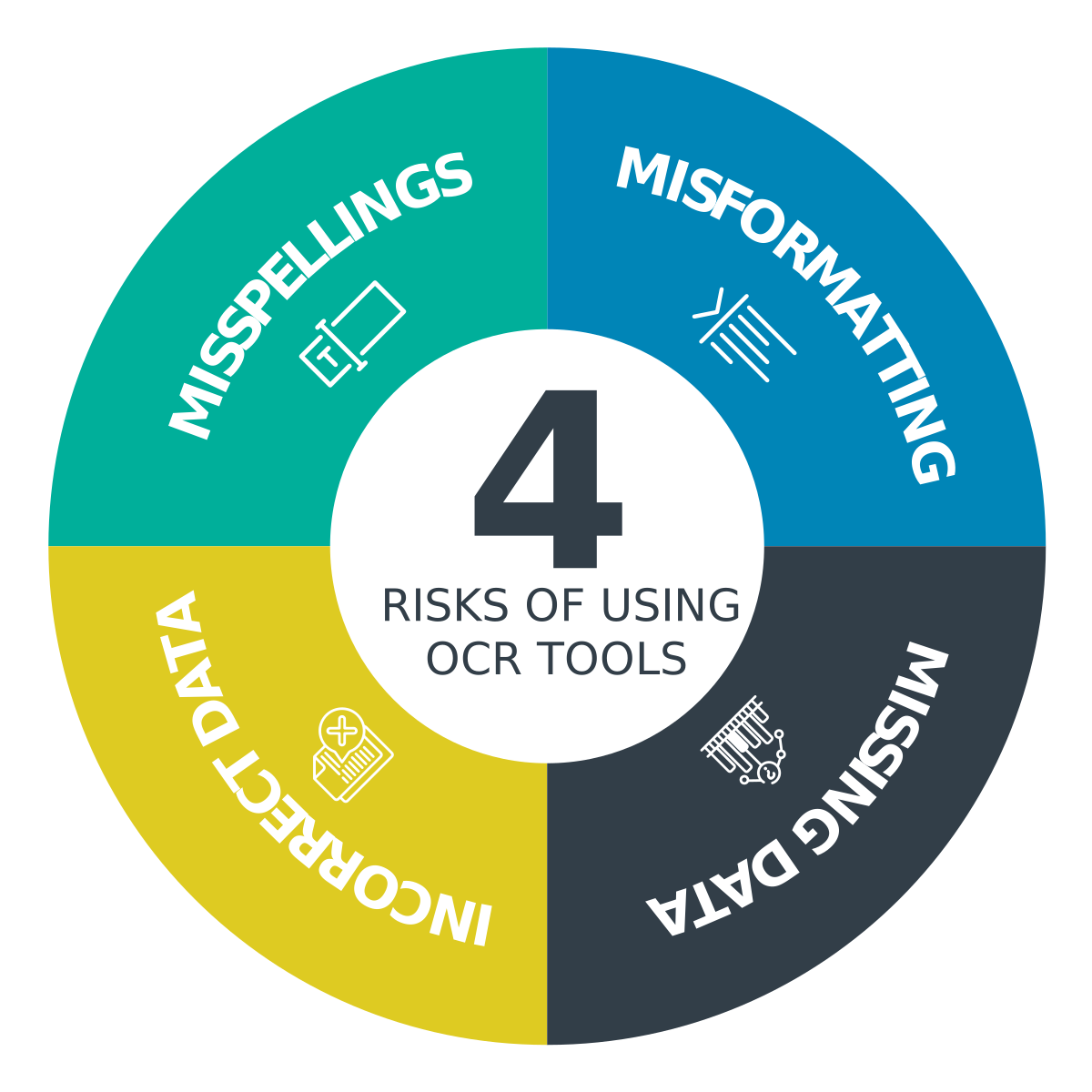
Some of the most common errors that can occur with OCR include:
- Misspellings – For example, a vendor name may scan incorrectly – choosing an S when it should be a 5 – causing the vendor to be entered into a health system’s ERP twice, leading to a duplicate payment.
- Misformatting – When a printed document contains a table with improperly aligned cells, OCR misformatting can occur, causing the character recognition tool to merge or split data inaccurately. This can lead to errors in data extraction and subsequent business processes.
- Missing data – One example is when a vendor sends a multi-page invoice, but only page one makes it into the imaging system from the OCR tool. Sometimes, multi-page invoices only display the amount due at the bottom of the last page. This could cause an over/underpayment if the tool picks up a subtotal or line item that is not the correct amount needed from the first page.
- Incorrect data – An example of this recently occurred at a health system when their system incorrectly recognized data. The health system’s tool picked up an erroneous page referencing an order summary adding the line to the invoice total. However, the line was only for reference and not a line item on the invoice causing the health system to overpay.
What’s at risk when using OCR?
Many OCR tools claim a 99+% accuracy, but that missing 1% can amount to millions of dollars spent on payment errors at large health systems. In 2022, US hospitals spent $4.35 trillion in expenditures; errors in 1% of those payments put $43.5 billion of healthcare spending at risk each year.
Moreover, complex layouts, tables, and formatting can pose challenges for recognition algorithms, often resulting in misinterpretations or incorrect data extraction and vendor code assignment. Handwriting and non-standard fonts also pose difficulties for character recognition tools to achieve accurate results. Furthermore, certain OCR tools may solely capture text, potentially missing valuable contextual information embedded in images or graphics.
Best Practices for Working with OCR:
To ensure the successful use of OCR tools, it is essential to consider the risk mentioned above and follow best practices.
- Prepare documents adequately before scanning or digitization to optimize accuracy.
- Put validation and verification processes in place to cross-check the accuracy of recognition tools against the original documents.
- Provide regular training and updates for OCR systems to keep them up to date with changing needs.
- Maintain a feedback loop for error identification and correction, involving human oversight and quality control measures.
- Continuously improve and adapt systems as new challenges and document formats emerge.
- Collaborate with technology experts to optimize OCR performance and address technical limitations effectively.
The Importance of Validation with a Third-Party Review
Even when following best practices, validation with a third-party review is paramount when utilizing OCR tools. Utilizing a third party provides a feedback loop for error identification and correction and is crucial to ensuring data outputs’ accuracy.
The expertise and objectivity of a third-party reviewer (like us) protect against payment errors, enhancing recognition tools’ overall quality and reliability.
Third parties objectively assess the processes and workflows around character recognition use. A third-party review can uncover overpayments and prevent future fund leakage by thoroughly examining the extracted data.
OCR tools have undoubtedly transformed AP and Supply Chain processes, providing efficiency, accuracy, and improved data management. However, it is crucial to approach OCR technology with caution. Despite its advancements, OCR technology still has limitations, and errors occur. Partner with us to scrub your data and review your spend to address and fix errors.